


Approximately two to three out of every 1,000 babies in the United States are born with some degree of hearing loss.[1] Because of the possibility of hearing loss, every newborn has their hearing screened shortly after delivery.
Early diagnosis is crucial for your child’s development. From the moment they’re born, babies begin learning through the sounds around them. They listen to voices, recognize familiar sounds and eventually start connecting words with meaning. Healthy hearing is an important part of developing those speech, language and communication skills.
By catching it early, you can start treatment and set your child up for success.
What Happens During the Hearing Screening?
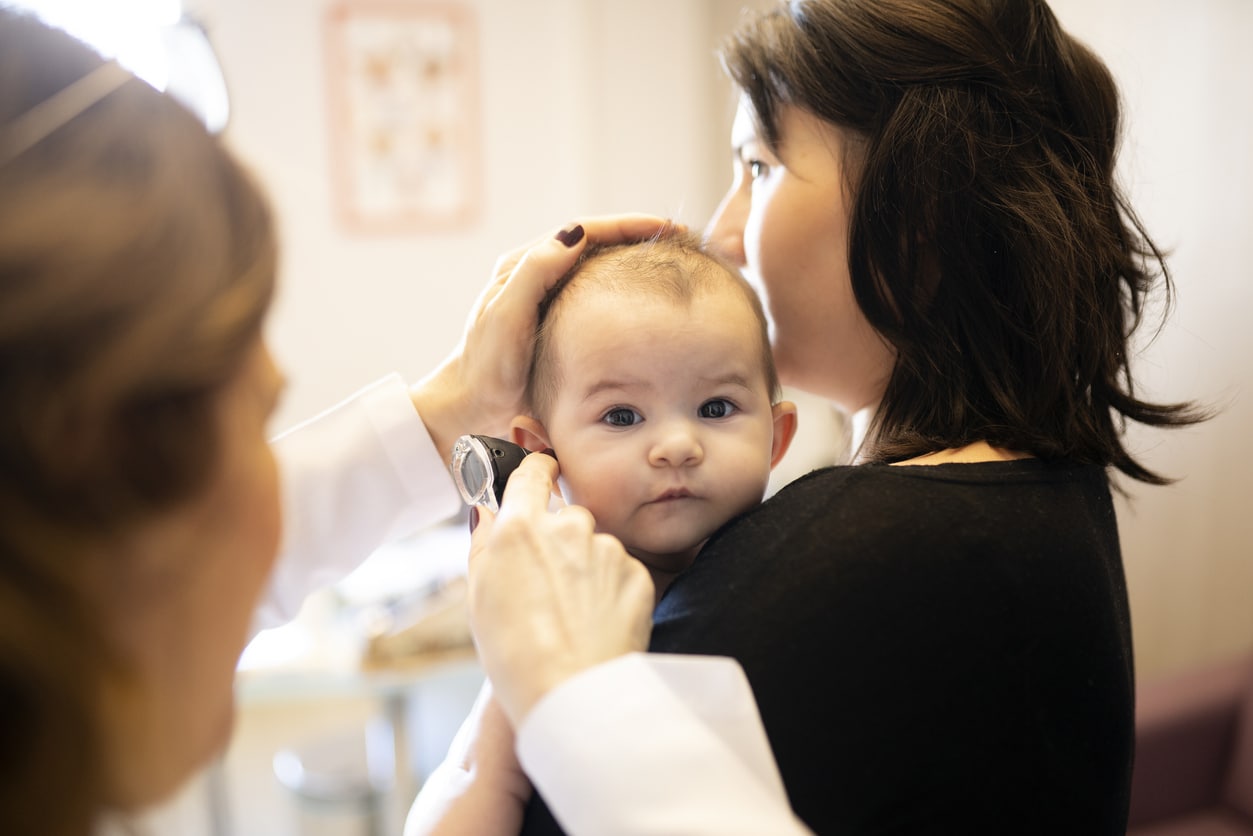
Newborn hearing screenings are quick, safe and completely painless; most babies sleep through the entire process.
Healthcare providers typically use one or both of these screening methods: Auditory Brainstem Response (ABR) and Otoacoustic Emissions (OAE).
Auditory Brainstem Response (ABR)
An ABR screening evaluates how well your baby’s hearing nerve and brainstem respond to sound. During the test, your baby wears small earphones that play soft clicking sounds. The nurse or doctor conducting the test will place adhesive sensors on your baby’s head to measure the brain’s response.
Otoacoustic Emissions (OAE)
An OAE screening measures how the inner ear responds to sound. Their provider will place a small earpiece in your baby’s ear and play gentle sounds through it. The equipment then records the ear’s response. Like the ABR, this test is comfortable and only takes a few minutes.
What If My Baby Doesn’t Pass the Screening?
Not passing the first hearing screening does not necessarily mean your baby has permanent hearing loss.
If your baby doesn’t pass, your provider will recommend a follow-up evaluation with a hearing specialist like one of those at Advanced Hearing. Additional testing can determine whether your baby has hearing loss and, if so, what type and severity it is.
If we confirm hearing loss, we can start treatment early to minimize the impact of the condition on your child’s life. Depending on your baby’s specific needs, treatment may include hearing aids, ongoing monitoring by an audiologist, speech and language services or, in some cases, cochlear implants when they’re old enough.
Finding out your child has hearing loss can be unnerving, but we’re here to help you every step of the way. Call our specialists at Advanced Hearing to schedule a follow-up exam for your little one.
[1] National Institute on Deafness and Other Communication Disorders. (2024). Quick statistics about hearing, balance, & dizziness. National Institutes of Health. https://www.nidcd.nih.gov/health/statistics/quick-statistics-hearing